Best URL structure for SEO: a complete guide for 2026
Best URL structure for SEO has become a more consequential question than it was a few years ago. Google’s ranking systems have gotten sharper at reading URL structure as a quality signal, and the gap between a well-structured URL and a sloppy one shows up in real ranking outcomes. Clean URLs rank better. Dynamic URLs with query strings rank too, but with friction. URL cloaking gets pages demoted or removed entirely. A lot of legacy advice on this topic is wrong for how 2026 search actually works.
I’ve audited URL structures on dozens of sites over the past two years – some launching new content systems, others migrating from legacy CMS platforms with terrible URL conventions. The patterns that produce results are consistent. The traps that hurt ranking are also consistent. What follows is the working guide: what a URL actually is, the principles that produce SEO-friendly URLs, how to handle dynamic URLs, what URL cloaking is and why to avoid it, and how to create well-structured URLs in practice.
Quick answer: best URL structure for SEO
The best URL structure for SEO is short, descriptive, lowercase, hyphen-separated, and keyword-bearing without being stuffed. A URL like /best-url-structure-for-seo ranks better than /blog/post?id=12847&cat=seo&utm=email. Avoid dynamic parameters where you can, never cloak URLs (showing different content to search engines than users), and keep your path depth shallow (no more than 3-4 levels under the domain). Use canonical URLs to prevent duplicate-content penalties when the same page is reachable via multiple paths.
What a URL actually is
Before getting into SEO best practices, naming the structural parts of a URL clarifies which parts matter and which don’t. A typical URL breaks down like this:
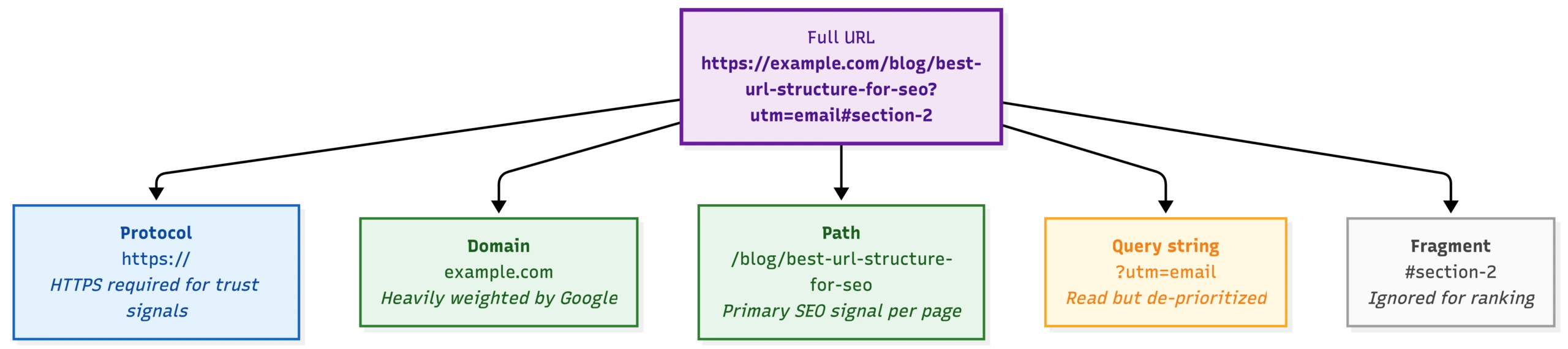
The protocol is https:// (or http://, though there’s no good reason to still serve over plain HTTP in 2026). The domain is example.com and is what people mean when they ask “what part of a URL is the domain.” The path is the part that identifies the specific page on that domain. The query string is the part after ? that passes parameters to the server. The fragment is the part after # that points at a section within the page.
For SEO purposes, the domain and the path are what matter most. Google reads the path heavily as a signal about what the page is about. Query strings are read but de-prioritized. Fragments are essentially ignored – they exist for in-page navigation, not for ranking.
This matters because most SEO advice about URL structure is really advice about path structure. Getting the domain right is mostly a one-time decision (you pick it, set up HTTPS, decide on www vs non-www); getting the path right is an ongoing discipline that affects every page you publish.
SEO URL structure principles that actually matter
The principles that produce ranking improvements are well-established and consistent across SEO research over the past several years.
Keep URLs short. Shorter URLs rank better on average than longer ones. The correlation isn’t perfect (long URLs can rank if other factors are strong), but the pattern is real. A URL with 3-5 words in the path outperforms a URL with 8-10 words in the path for similar content. Aim for the shortest URL that’s still descriptive.
Use descriptive, keyword-bearing paths. The URL should tell a human reader what the page is about. /best-url-structure-for-seo does this. /post-12847 does not. Include the target keyword in the URL naturally – not stuffed, not repeated, just present once where it fits.
Lowercase everything. Some servers treat uppercase and lowercase URLs as different pages, which creates duplicate-content problems. Lowercase URLs avoid this entirely and are the convention every modern CMS defaults to.
Hyphens, not underscores. Google has been explicit on this point: hyphens are treated as word separators, underscores are not. /best-url-structure reads as four words to Google. /best_url_structure reads as one word. Always use hyphens.
Keep path depth shallow. A page at /posts/best-url-structure-for-seo is fine. A page at /blog/2025/november/seo/posts/best-url-structure-for-seo is over-structured. Path depth past 3-4 levels signals content buried deep in site hierarchy, which Google reads as a quality signal against the page.
Avoid special characters and spaces. Special characters get URL-encoded into ugly strings. Stick to alphanumerics, hyphens, and forward slashes.
Dynamic URLs versus static URLs
Dynamic URLs use query parameters to pass information to the server: /products?id=1234&category=shoes&color=blue. Static URLs encode the same information in the path: /products/shoes/blue/1234. The SEO difference between them is real but smaller than commonly believed.
Dynamic URLs can rank fine when they’re stable, indexable, and don’t include session IDs or user-specific parameters. Major e-commerce sites have ranked dynamic URLs for years. The friction shows up in three places: dynamic URLs are harder to read and share, they can create duplicate-content issues if multiple parameter combinations produce the same content, and they look less trustworthy in search results compared to clean static URLs.
Static URLs are preferred for any content you’re actively trying to rank because they’re cleaner, more shareable, and signal more deliberate site structure. Most modern CMSes generate static-looking URLs even when the underlying system is database-driven, which is the right pattern for SEO regardless of what the backend does.
The realistic split: if you’re building a new site, use static URLs by default. If you have a legacy system with dynamic URLs that ranks fine, don’t migrate just for theoretical SEO benefit. If you have dynamic URLs that aren’t ranking well, restructuring to static is one of the higher-leverage SEO moves you can make.
For dynamic URLs you can’t migrate, use canonical tags to designate the preferred version, configure your CMS to ignore tracking parameters (like utm_source) in the canonical URL, and avoid generating URLs that combine parameters in ways that produce duplicate pages.
URL cloaking: what it is and why to avoid it
URL cloaking is the practice of showing search engines a different URL or different content than what users see. It’s been around since the early days of SEO and Google’s been demoting it just as long. In 2026 the detection is sophisticated enough that cloaking is essentially a guaranteed way to get pages or entire sites demoted.
The pattern shows up in a few forms. Server-side cloaking detects search engine crawlers by user-agent or IP and serves different content. Sneaky redirects show one URL in search results and redirect users to a different page. Hidden text or hidden URLs include keyword-stuffed content that’s invisible to users but readable to crawlers.
Google’s Webmaster Guidelines explicitly prohibit all of these, and the algorithmic detection has improved significantly. Sites caught cloaking lose ranking rapidly and recovery takes months even after the cloaking stops.
The honest framing: there’s no legitimate SEO reason to cloak URLs. The shortcuts cloaking promises – higher rankings without doing the underlying work – don’t pay off because the detection is too good. If a strategy depends on showing search engines something different from users, it’s a strategy that will eventually get caught and demoted.
The legitimate adjacent practices are different things: A/B testing (where Google should see the canonical version), localization (where Google indexes localized URLs separately), and personalization (where the URL stays the same but content varies by user). These are fine. Cloaking proper is not.
How to create well-structured URLs in practice
How to create a URL that ranks well in 2026 comes down to a few practical decisions you make once and apply consistently.
Decide your URL pattern up front. For a content site, common patterns are /category/post-slug or just /post-slug. For e-commerce, /category/subcategory/product-slug works well. The specific pattern matters less than consistency – pick one and apply it everywhere.
Generate slugs from titles, not from IDs. When you create a new page, the URL should derive from the title (/best-url-structure-for-seo) rather than an internal database ID (/page-1247). Most modern CMSes handle this automatically.
Manually edit slugs when the auto-generated version isn’t ideal. Auto-generation usually produces reasonable slugs but occasionally produces verbose or awkward ones. Take ten seconds to clean these up before publishing. A slug like /the-best-url-structure-for-seo-in-2026-complete-guide should become /best-url-structure-for-seo.
Don’t change URLs after publication if you can avoid it. Every URL change requires a 301 redirect from the old URL to the new one, and you lose some link equity in the process. If you must change a URL, set up the 301 immediately and update internal links to point at the new URL directly.
Handle URL casing and trailing slashes consistently. Pick lowercase, pick either trailing slash or no trailing slash, and apply the same choice everywhere. Server configuration should redirect from non-canonical forms to canonical ones to prevent duplicate-content issues.
FAQ
If you’ve migrated URL structures on a real site and have data on what changed in rankings or traffic, that writeup is the gap worth filling. Most SEO content on URL structure rehashes the same principles without measurement. Real before-and-after numbers are what helps the next wave of SEO work calibrate against actual outcomes.
